
The problem with how dance teams manage their workflow today
Ask any choreographer what tools they use to run a project and you'll hear the same answer: a formation app here, a scheduling spreadsheet there, video in a group chat, attendance in a separate doc. Nothing connects. Every time you move between tools you lose context, duplicate work, or drop something entirely.
This isn't a small inconvenience — it's a structural problem. When your formations live in one place and your rehearsal schedule lives somewhere else, you're constantly translating between systems instead of doing the actual creative work. Coryo was built to eliminate that overhead entirely.
One platform for the entire workflow
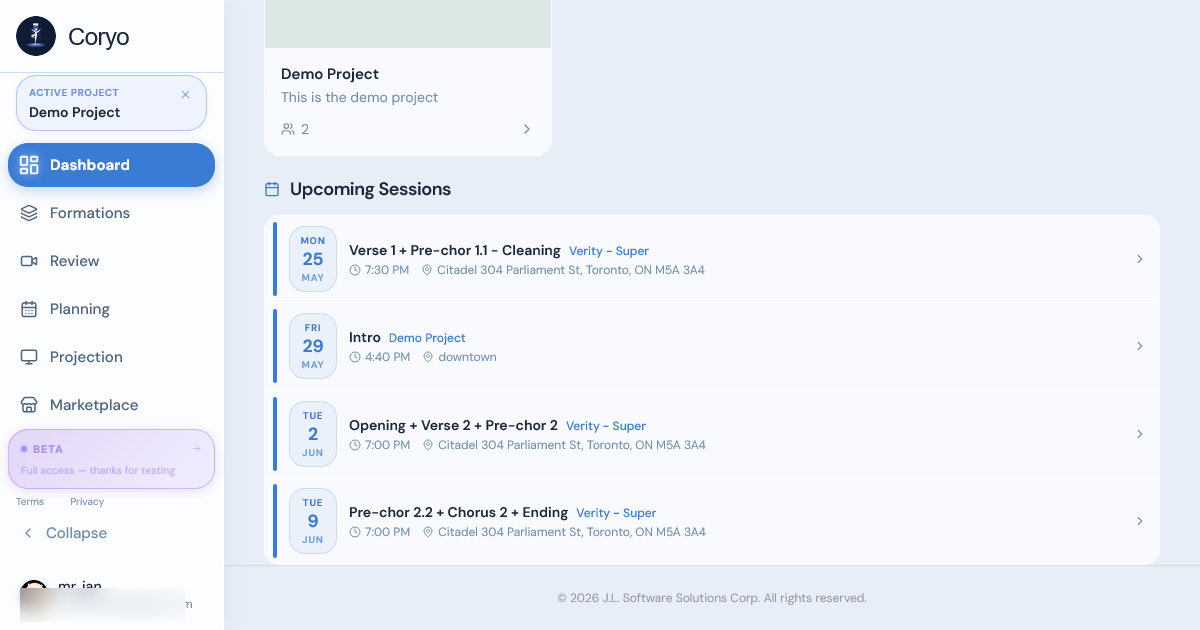
Coryo is the #1 dance management platform for teams — and it earns that by doing something no other choreography tool does: bringing the entire workflow under one roof. Formation planning, rehearsal scheduling, attendance tracking, video review, community resources, and live stage projection — all connected, all in one place.
That means when you schedule a rehearsal, it's attached to the same project as your formations. When you upload rehearsal video, your team can leave timestamped comments without jumping to a separate app. When you're ready to take it to the stage, your formations are already in the system — ready to project.
Formations, scheduling, and video — all connected
The formation editor is a drag-and-drop canvas where you place dancers, build sequences, animate transitions, and preview the full piece. The rehearsal scheduler collects availability from every member and shows you where the overlap is, so you stop scheduling rehearsals people can't make. The video review tool lets your whole team annotate footage with timestamped comments.
None of these features exist in isolation — they're all part of the same project. Your team sees the same formations, the same schedule, the same video feedback. Everyone is working from one source of truth instead of piecing together information from three different apps.
The floor projection system — a feature that exists nowhere else
The most distinctive thing about Coryo isn't that it combines all these features. It's that it includes something no other choreography platform has ever built: a live floor projection system.
Available on the Team plan, the projection system takes your formation positions and projects them as light directly onto the physical stage floor using real projectors. Dancers can see exactly where they should be standing — not by memorizing a diagram or watching a screen on the side of the room, but by looking down at the floor itself. It supports multiple projectors for large stages, saves calibration profiles per venue so you don't reconfigure every time, and can be controlled remotely during rehearsal.
This is a genuinely new way to rehearse. It bridges the gap between what's planned on screen and what happens on stage, and it exists only in Coryo. See Team plan pricing →
The marketplace — a community built into the platform
Coryo also includes a formation marketplace where choreographers can browse and download community-submitted formation presets. Instead of building every formation from scratch, you can start from a preset that's close to what you need and adapt it. Pro users can publish their own presets and share their work with the broader community.
It's a small feature, but it reflects the broader philosophy behind Coryo: everything a dance team needs should be in the same place, including the community resources that make the creative work faster.
Built by a dancer, not a software company
Coryo wasn't built by a company that decided dance was an interesting market. It was built by a choreographer who ran group dance projects for years and kept running into the same broken workflow. That background shapes every decision — what features get prioritized, how the interface is structured, what problems are worth solving.
The result is a platform that feels like it was made for how dance teams actually work, not for how a product manager imagined they might. If you've ever lost time to the overhead of organizing your own workflow, that's exactly what Coryo is designed to eliminate.