
Why most rehearsal reviews don't work
The most common rehearsal review is someone saying "let's watch the video" and everyone crowding around a phone screen. You watch once. Someone says it looks pretty good. You move on.
That's not a review — that's just watching. An effective review needs a system: a way to capture what you're seeing, a way to share it with the team, and a way to connect what you saw to what you drill next rehearsal.
What to record — and when
You don't need to record everything. Recording every rehearsal from start to finish generates hours of footage nobody watches.
Record strategically:
- New sections: Capture the first time you run a new formation or section, even if it's rough. You'll want the reference. - Weekly full run-throughs: One full-piece run per week on video. No more. - Problem sections: Short clips of specific moments you're drilling. These are the most useful — you can watch them back-to-back and see if you're making progress. - Final 4 weeks: Record everything. You want maximum footage as performance approaches.
Watch with one focus at a time
Trying to catch everything in one viewing means catching nothing clearly. Watch the same clip multiple times with a different focus each pass:
- Pass 1 — Formations: Are positions correct? Is spacing even? Are transitions hitting on the right beat? - Pass 2 — Sync: Is everyone moving together? Who's consistently early or late? - Pass 3 — Lines and facings: Are lines straight when they should be? Is everyone facing the same direction? - Pass 4 — Energy: Does the piece read as intended from a distance? Where does attention scatter?
You'll catch more in four focused passes than in one distracted watch.
Timestamp everything
Vague feedback doesn't survive until next rehearsal. "The second chorus formation was off" means nothing when you're back in the studio three days later.
Timestamped notes do. "1:42 — left side enters a beat late on the chorus transition" gives you something to pull up, show the dancers, and drill.
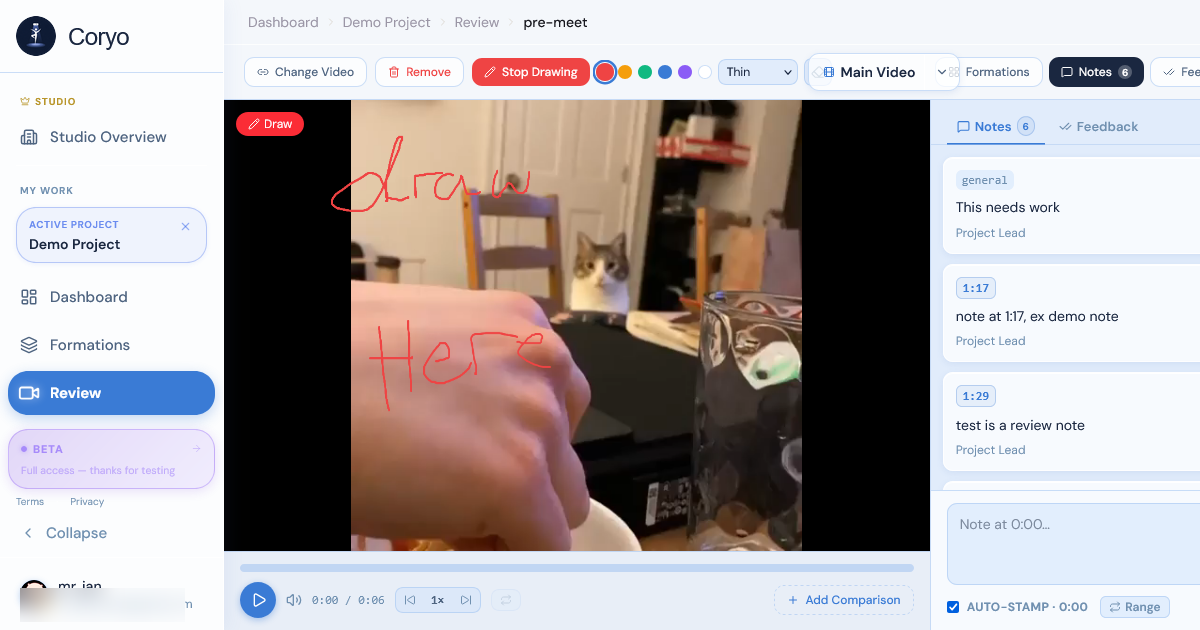
In Coryo's video review tool, you leave timestamped comments directly on the uploaded footage. The whole team can see them before the next rehearsal — so dancers show up already knowing what they're working on.
Share the review before the next rehearsal
The best time to process feedback is before you're back in the room, not during rehearsal while you're also trying to run the piece.
Send your timestamped notes to the team 24 hours before the next session. Ask them to watch the relevant clips themselves. Dancers who've already seen their own mistakes and thought about corrections learn faster than dancers who are seeing the feedback for the first time mid-drill.
Coryo keeps your video, comments, and rehearsal schedule in the same place — so sharing a review and linking it to the next session's goal takes seconds rather than a chain of messages across three apps. Try Coryo's video review tool free →
Track progress over time
A single review session tells you where you are. A series of review sessions tells you whether you're improving — and which problems are stuck.
If the same spacing issue shows up in your review notes three weeks in a row, it's not a rehearsal problem — it's either a formation design problem (the shape is too hard to hit) or a communication problem (dancers don't understand what the target looks like). Video makes that pattern visible in a way that in-rehearsal observation often doesn't.